



Introduction
Your hall is booked for PE on Monday, exams on Wednesday, and the Year 6 production on Friday. Sound familiar?
For most UK state schools, finding space is a constant challenge, let alone trying to find a dedicated performance space. The right school staging system doesn’t just solve that problem; it opens up what’s possible for drama, music, and the wider curriculum.
Budgets are tight. Timetable space is even tighter. And the pressure on arts provision in schools is well documented. But investing in a flexible, modular stage system means you don’t have to choose between giving students a quality performance space and keeping everything else running.
This guide covers everything you and your school needs to know about supporting drama, music and performances using staging, from flexibility and safety to accessibility and cost.
Flexibility: The Most Important Feature of Any School Stage
Performance spaces in schools, particularly in primary, are almost always multi-use environments, which is why flexibility should be at the top of your list when evaluating a portable staging system for your school. The hall serves as PE space, exam hall, assembly venue, and dining room. So, a staging solution that disappears as quickly as it appears is what you need.
Space & Configuration
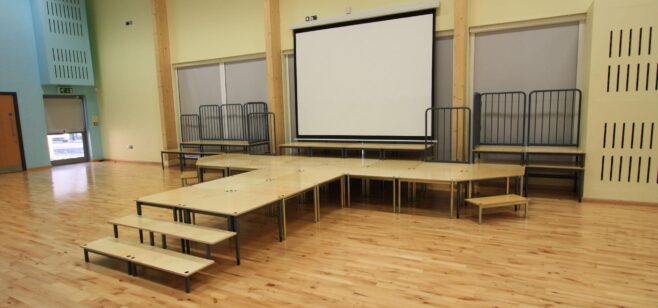
A modular stage system gives your school genuine versatility. The same components that form a low concert platform can be reconfigured into stepped choir risers or a mid-height drama stage. You can even use modular staging to extend an existing permanent stage, dramatically expanding your performance capacity without major construction.
Modular staging also works for the audience. The same system that creates a stage can be used to build temporary tiered seating arrangements, which maximise sightlines and are then dismantled and stored in minutes.
Quick Turnaround
Schools often need to turn spaces around between events with very little notice. A well-designed modular system makes this manageable, even for a small team or for students themselves (more on that below).
Safety & Compliance: What Schools Need to Know
A staging system is only as good as its safety record. For schools, this isn’t just about duty of care; it’s about complying with Ofsted, fire inspectors, and insurers, all of whom require documented evidence of compliance.
Look for systems that exceed BS6399 requirements for loading and that come with full technical documentation. Handrails, edge protection, and stable interlocking components are non-negotiable for safety. But, they also provide students, who might otherwise be anxious about performing, confidence in their environment by removing unnecessary anxieties.
As you already know, schools have a duty to make reasonable adjustments for students with disabilities. These allowances create an inclusive environment, breaking down barriers between students with special educational needs (SEN) and their neurotypical or able-bodied peers. The Stage Systems products support a range of requirements through additional accessories and customisations.
Easy Setup & Storage: Designed Around How Schools Actually Work
In most schools, staging, chairs, and equipment live in cupboards, corridors, or a dedicated store adjacent to the hall. With storage being a primary constraint on what schools decide to purchase, any staging system you consider must be compact when stored and quick to deploy.
Stackable platforms, nesting components, and a clear, tool-free assembly process are essential. An added bonus are systems that can be put together by students with minimal supervision, creating its own set of educational benefits.
“The Q-build design has enabled us to create amazing performances, and get the students completely involved with creating different stage layouts.”
Involving students in stage builds opens doors to behind-the-scenes roles in the arts for stage management, set design, carpentry, etc that many young people don’t know exist. For students who aren’t performers, this can be the entry point that keeps them engaged with arts subjects for years to come.
Accessibility & Inclusivity: Staging that Works for Every Student
Drama, music, and performing arts are powerful tools for learning, self-expression, and personal development, particularly for students with special educational needs. But that potential is only realised if the physical environment supports participation, not just observation.
As briefly touched on above, a good school staging solution can be configured with ramp sections for wheelchair users and students with limited mobility, ensuring every student can take part. The same principle applies to seating: the ability to mix seating types in one configuration. Standard seats, wheelchair spaces, and additional support chairs all matter far more than aesthetic uniformity.
Choosing accessible staging is part of creating an impactful curriculum and genuinely inclusive arts programme.
Curriculum Impact: Unlocking Arts Provision Across Key Stages
The majority of UK state schools don’t have access to a dedicated performance space. Without the right infrastructure, arts subjects are squeezed out, and extracurricular performance opportunities, which research consistently links to broader student wellbeing, become difficult to sustain.
A modular staging system changes that by transforming the space you already have. Primary schools are generally strong on the arts, with the annual nativity, seasonal concerts and end-of-year productions being just a few examples. But that energy often fades at secondary level. The right staging system supports continuity, from KS1 right through to sixth form.
Without additional equipment or tools, the same platform can serve as a drama stage, a podium for award ceremonies, or a backdrop for a school debate. That versatility is what makes staging systems a school-wide, curriculum asset, not just a drama department purchase.
Budget: Making the Investment Work for your School
School budgets are under sustained pressure, and any significant purchase needs to demonstrate value across departments and over time.
As mentioned in the previous section, the stages from Stage Systems can be used across the school, inside and outside. A single system can support a range of subjects and additional events like assemblies, award ceremonies, and visiting speakers. This spreads the cost per use across your whole school, and across your multi-academy trust.
Second, modular systems don’t have to be purchased all at once. Schools new to staging can start with a core kit and add platforms, accessories, and ramp sections over time, spreading investment across financial years and responding to actual usage needs as they become clear.
Finally, quality modular systems are built to last. A system purchased today, maintained well, should still be in use a decade later, making the cost per year considerably more modest than the headline figure suggests.
Ready to Find the Right Staging for Your School?
The right school staging system does more than create a stage. It gives students the infrastructure to perform with confidence, supports inclusive participation, keeps the arts alive across all key stages, and makes the most of the space you already have.
Every school is different. Space constraints, budget cycles, student age ranges, and curriculum priorities all vary. That’s why the Stage Systems team works with you to specify a system that fits your exact requirements.
Get in touch to request a free, no-obligation quote tailored to your school.